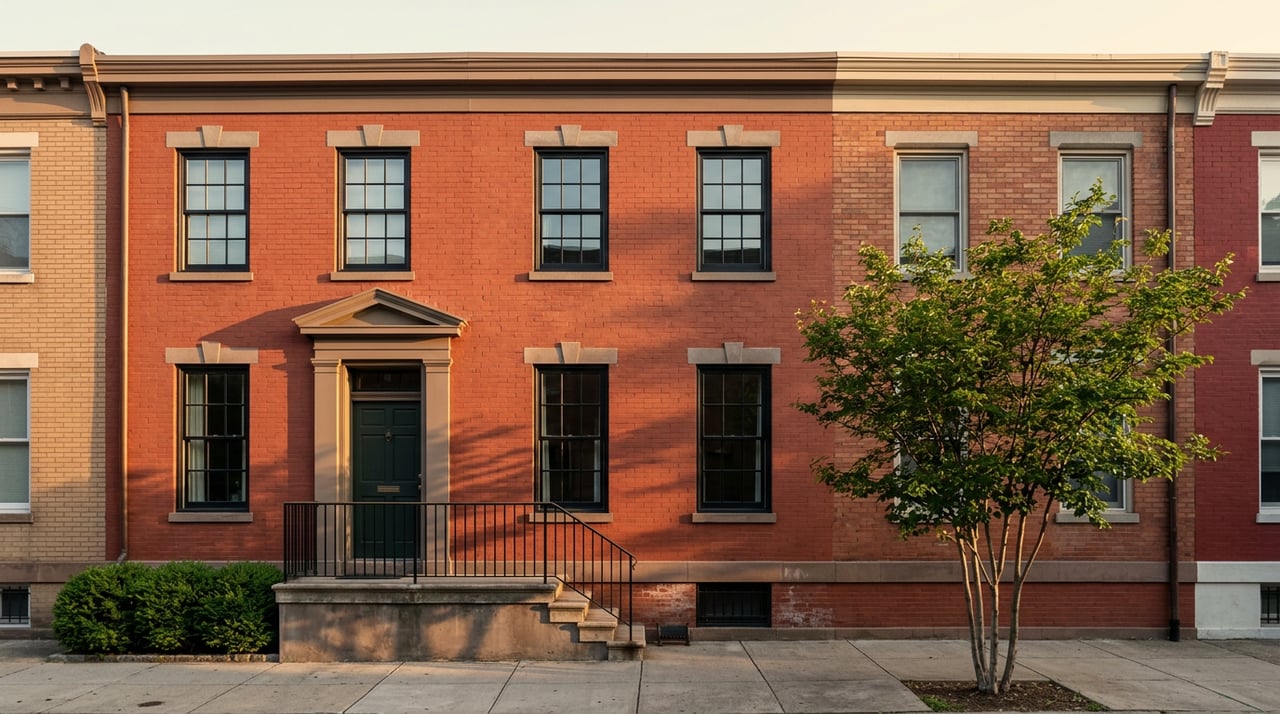
The portals will tell you East Orange is a $512,000 market, or a $572,000 market, or a $394,000 market, depending on which one you check first. All three numbers are defensible. None of them describe the deal a buyer actually underwrites here in 2026.
The transaction that moves in East Orange right now is a two-family. It clears at a different price, on a different clock, against a different set of comps, and its economics are being rewritten in real time by roughly 820 new rental units under construction eight blocks from City Hall. If a buyer is comparing East Orange to Bloomfield, Orange, or Vailsburg using single-family medians, they are reading the wrong instrument.
The single-family median is a red herring
Pull the recent data side by side and the disagreement is the story. Redfin put the East Orange three-month median at $512,000 for the period ending May 2026, down 5.8% year over year, with homes averaging 87 days on market. Houzeo pegged the March 2026 median at $572,000, sale-to-list at 105.27%, with 3.4 months of supply. Movoto's June 2026 read was a $475,000 list-price median at 54 days. Zillow's typical value index sat at $394,402, up 11.6% over the year.
These are not four right answers. They are four different baskets. Redfin and Movoto skew heavily to sold transactions; Houzeo weights active listings; Zillow smooths across every parcel it can index, including deep-value stock in the older housing base. What none of them isolate cleanly is the segment that actually drives East Orange purchase activity: legal two-family homes bought by owner-occupants planning to rent one unit.
On Redfin, that sub-market showed 36 active two-family listings at a $699,000 median list price, 66 days on market, and an average of three offers per home. Homes.com and Realmo showed a wider inventory funnel of 58 to 77 multifamily listings averaging around $1.27 million, with a range from $350,000 to $8.2 million once small apartment buildings are included. The two-family layer sits well above the single-family median, moves faster than the citywide days-on-market figure, and prices off rent, not comps.
What a two-family price is really quoting
The listings themselves read like a spec sheet for a specific buyer profile. Across active inventory in the Elmwood, Upper Roseville, Ampere, Seven Oaks, and Ward 1 pockets, the recurring pattern is:
- Two units of roughly equal size, three bedrooms over three bedrooms being the most common configuration
- A finished or semi-finished basement pitched as a bonus rec room, not counted toward legal unit count
- One or two off-street parking spaces flagged as a premium feature
- Separate utilities on renovated stock, shared systems on value-add stock
- A share of new construction two-families near the Glen Ridge and Montclair borders offering five-year tax abatements
The pricing gap between renovated turnkey and cosmetic value-add is the widest single lever in the market. A recently gut-renovated two-family with separate utilities and permits closed in 2025 lists closer to the $850,000 to $1.1M band. A vintage two-family sold as-is with tenant-occupied units and deferred systems can still trade in the low $500,000s. The $699,000 median is doing a lot of averaging.
The pipeline repricing the rent roll
The reason the two-family segment behaves the way it does is that its underwriting is not a real-estate question. It is a rental-market question, and the East Orange rental market is being reset by one address.
The Crossings at Brick Church Station is a $500 million, mixed-use redevelopment on Main Street directly adjacent to NJ Transit's Brick Church stop, a 25-minute Midtown Direct ride into Penn Station. Co-developed by Triangle Equities and Incline Capital, the full build-out delivers roughly 820 residences and more than 200,000 square feet of retail across two phases. Phase 1 includes Embark at The Crossings, 400 mixed-income apartments from studios to three-bedrooms, plus a new 61,000-square-foot ShopRite, a 1,200-space parking garage, and confirmed retail leases from Burlington (48,900 sf), Five Below (9,600 sf), Rainbow (6,400 sf), Dunkin', and Rita's Italian Ice, reported by Jersey Digs in June 2026.
In February 2026, the project closed a $133.5 million recapitalization, led by a $115 million bridge loan from Fortress Investment Group affiliates and $16.5 million in LIHTC equity from Affordable Equity Partners, per ROI-NJ. Phase 2, a 420-unit component that landed a $298 million Aspire award, is under construction on a 25-month timeline. Institutional capital is also actively transacting on stabilized product: CBRE brought a 209-unit Class-A East Orange portfolio to market in May 2026, pairing The Modern (119 units) with 227 North Walnut (90 units), both delivering long-term PILOTs. In March 2026, ICON Real Estate Advisors arranged the $7.95 million sale of the 58-unit multifamily at 223 Prospect Street. On July 3, 2026, the city approved a 100-unit complex on William Street inside the Transit Village District, tracked by NJTOD.
Read as a single system, these numbers set the ceiling and the floor on what a two-family owner can charge for a renovated apartment on Halsted Street or North Walnut.
| Segment | Typical asking | Time to lease/sell | What sets the price |
|---|---|---|---|
| Single-family, resale | $475K–$572K | 54–87 DOM | Comps, condition |
| Two-family, resale | $699K median list | ~66 DOM, 3 offers | Rent roll, unit count |
| New two-family, abated | $900K–$1.3M | Faster on abatement | Post-abatement tax math |
| New Class-A rental (Embark, The Modern) | $2,400–$3,400/mo effective | Lease-up windows | TOD supply, PILOT terms |
Where investor math and owner-occupant math split
The dominant buyer archetype for an East Orange two-family in 2026 is not an institutional investor. It is an owner-occupant house-hacker, often a first-time buyer, running FHA or a low-down-payment conventional. Several active listings this cycle carried lender-attached programs at 5% down with no PMI at rates in the low fives. That financing changes the deal.
An investor underwriting a $699,000 two-family at a 25% down, non-owner rate needs both units renting at market to clear debt service, and the market rent is now competing with a brand-new studio at Embark that comes with a fitness center, a rooftop, and a 90-second walk to a Midtown train. That competition compresses achievable rents on the older stock unless the two-family unit offers something the tower cannot: a yard, a garage, a full three bedrooms at a family price point.
An owner-occupant putting 5% down on the same building only needs one unit to rent. Their break-even is far lower, their financing is far cheaper, and the tower down the street is not a competitor because the tower does not sell them equity. That is why two-families in East Orange are still receiving three offers at 105% of list while single-family days-on-market drifts toward 90.
The mispricing is not in the median. It is in the assumption that a single buyer pool is bidding on both product types.
The friction that surfaces at contract
A two-family purchase in East Orange carries transaction-specific friction that a generic Essex County guide will not flag. The five recurring ones we see:
- Tenant status at signing. A meaningful share of listings are sold occupied, sometimes month-to-month, sometimes on legacy leases at below-market rent. "Delivered vacant" is negotiable but not automatic. Confirm in writing before appraisal ordering.
- Legal versus non-conforming use. Some active listings are marketed as two-family setups that are legally single-family under current zoning. Financing, insurance, and future resale all shift on that distinction. Certificate of occupancy history from the City of East Orange building department is the document that resolves it.
- Zoning overlays. The R-4 Multifamily District and the North Walnut rezoning area create value-add and redevelopment optionality that older listings do not price in. A buyer holding for five years may care more about the overlay than the current rent.
- PILOT and abatement disclosure. New construction two-families are frequently sold with five-year abatements running. The reset year is the year the buyer's carrying cost jumps. Model it before you offer, not after inspection.
- Inspection patterns on pre-1940 stock. Knob-and-tube remnants, oil tanks with no closure records, and shared sewer laterals with detached garages come up often enough that a plumbing scope and a specific tank sweep belong in the standard scope, not the à la carte one.
Reading the next twelve months
The market read for late 2026 into 2027 is not a directional call on prices. It is a call on which segments move first. Phase 1 of the Crossings lease-up will absorb the first wave of tenant demand that would otherwise flow to older two-family units, which likely widens the rent gap between renovated and unrenovated stock. That gap creates the value-add case for investors, and it protects the owner-occupant case for buyers who can accept a longer stabilization runway on the second unit.
The single-family median will keep behaving erratically because the sample is small and the mix is unstable. The number to watch instead is the two-family sale-to-list ratio and the ratio of tenant-occupied to vacant closings inside the Transit Village half-mile. Those two data points, tracked together, tell a buyer more about the East Orange market than any portal median will.
FAQ
Is a two-family in East Orange still an owner-occupant play, or has it become an investor market? As of mid-2026, both, and they are pricing the same asset differently. Owner-occupants with sub-10% down programs are winning bids at 105% of list on renovated stock. Investors are more disciplined on unrenovated stock priced against a rent roll that has to compete with new Class-A supply.
Does the Crossings at Brick Church make surrounding two-family values go up or down? It raises land value and long-term appreciation prospects inside the Transit Village overlay. It compresses achievable rents on unrenovated units in the short term because the new supply is newer, closer to transit, and amenity-rich. Those effects can coexist.
How much of the recent price data is signal, and how much is mix? Enough of it is mix that any single median should be treated as a starting question, not an answer. The three-month Redfin figure and the two-family median list are the two anchors worth carrying into a comp conversation.
Pricing a two-family in East Orange right now is a rent-roll exercise wrapped in a zoning question wrapped in a lease-up forecast. If you are weighing an acquisition, a sale, or a hold decision inside the Brick Church half-mile, The Arrived Team at Compass underwrites these deals from the same seat you are sitting in. Work With Us.